Motivation
AI coding agents are only as good as the context you give them. When I started using them seriously across several repos (ECS extraction jobs, dbt, this website), I kept hitting the same problems:
- Every tool wants its own config: Claude Code reads
CLAUDE.md, Codex readsAGENTS.md, Cursor has its own rules file. Duplicating instructions per tool guarantees they drift apart. - Lessons didn’t stick: I would correct an agent, and a week later a different agent (or the same one in a new session) made the exact same mistake.
- Conventions were repeated everywhere: how to run Python, how to name branches, how to write a Jira ticket. Same rules, copy-pasted into every repo, each copy slowly rotting.
This post describes the setup I converged on: one entrypoint per repo, a shared skills repo mounted as a git submodule, every lesson committed as markdown or enforced by a hook, and a plan-first workflow that survives lost sessions.
The big picture
The whole setup is built around one principle: agent instructions are code. They live in the repo, they are reviewed in PRs, they have a single source of truth, and they are linted by pre-commit hooks.
In each repo, the layout looks like this:
repository/
├── AGENTS.md                  # entrypoint + router (repo-specific)
├── .agents/
│   ├── shared/                # shared playbooks repo, as a git submodule
│   │   ├── playbooks/         # always-on rules
│   │   └── skills/            # task-triggered skills
│   └── local/                 # repo-specific playbooks and skills
├── .claude/skills/<name> ->   # committed relative symlinks into .agents/
└── .codex/skills/<name>  ->   # (so each tool auto-discovers the skills)
When instructions conflict, precedence is explicit:
- Direct human instruction
- Repo-specific instructions in
.agents/local/ - Shared instructions in
.agents/shared/ - General agent defaults
Repository-specific instructions always override shared ones. That’s what makes a shared repo safe: any repo can opt out of a rule locally without forking the shared content.
One entrypoint: AGENTS.md, never tool-specific files
Each repo has a single AGENTS.md that any agent reads first.
It covers the architecture, the key abstractions, the required commands, and it routes to the playbooks and skills for everything else.
CLAUDE.md is literally one line:
# CLAUDE.md

See [AGENTS.md](AGENTS.md).
The rule is strict: all shared guidance lives in AGENTS.md or .agents/, never in a tool-specific location.
A .claude/ file is invisible to Codex, and both are invisible to a teammate browsing the repo.
Provider-neutral markdown works for every agent and every human.
And because rules that depend on discipline eventually get broken, a pre-commit hook enforces it:
- id: no-tool-specific-agent-guidance
  name: no tool-specific agent guidance (use .agents/)
  entry: >-
    Shared agent guidance must live in .agents/ or AGENTS.md,
    not in tool-specific locations.
  language: fail
  files: '^(\.claude/|\.cursor/|\.cursorrules$|.*/skills/)'
  exclude: '^\.agents/'
I use prek as a faster drop-in replacement for pre-commit. Same .pre-commit-config.yaml, no Python bootstrap needed.
A shared skills repo, mounted as a submodule
Most guidance is not repo-specific: how to run Python through uv, how to name branches, how to review a PR, how to format a Jira ticket.
That content lives in a dedicated repo (in my case it’s called data-agents-playbooks, but any name works) that every consuming repo mounts as a git submodule at .agents/shared/.
The shared repo has two kinds of content:
- Skills (
skills/<name>/SKILL.md): task-triggered workflows. Both Claude Code and Codex natively support the sameSKILL.mdformat: thename/descriptionfrontmatter is always in the agent’s context, and the full instructions load only when the task matches. - Playbooks (
playbooks/<topic>.md): always-on behavioral rules that apply from the first turn of every session, routed fromAGENTS.md. Skills load lazily by design, so rules that must apply from turn one can’t be skills.
A skill is just plain markdown with a small header, so it also works for humans and for agents without skill support:
---
name: python-and-versioning
description: Use when running Python code or tools, writing a new
  Python module, or when bumping a package version. Covers uv run,
  module-header comments, and semver bumps with bump-my-version.
---

# Python and versioning
...
Why a submodule and symlinks
Skills are discovered per tool (.claude/skills/, .codex/skills/), so each consuming repo commits relative symlinks from those paths into the submodule.
This gives you:
- One copy of the content: no sync scripts, no drift between copies.
- Pinned, reviewable updates: the submodule points at a commit. Each repo decides when to pick up changes, and the bump shows up in a PR diff.
- Works on a fresh clone: git stores symlinks as regular objects, so everything works right after
git submodule update --init.
The symlinks themselves are created by a small script in the shared repo, so no repo ever hand-maintains them. This is the core of it (trimmed for the post):
SHARED_SKILLS=".agents/shared/skills"
LOCAL_SKILLS=".agents/local/skills"
TOOL_DIRS=(".claude/skills" ".codex/skills")

SOURCES=("$SHARED_SKILLS")
[[ -d "$LOCAL_SKILLS" ]] && SOURCES+=("$LOCAL_SKILLS")

for tool_dir in "${TOOL_DIRS[@]}"; do
    mkdir -p "$tool_dir"

    for source in "${SOURCES[@]}"; do
        # Relative path from the tool dir back to the source dir.
        rel_target="../../$source"

        # Link every skill (directories containing a SKILL.md).
        for skill_path in "$source"/*/; do
            [[ -f "$skill_path/SKILL.md" ]] || continue
            skill="$(basename "$skill_path")"
            ln -sfn "$rel_target/$skill" "$tool_dir/$skill"
        done
    done
done
The real version is idempotent, never touches non-symlink entries, and prunes links whose skill was removed. Updating a repo to the latest shared playbooks is one script that bumps the pin and re-runs the linking, committed as its own commit.
Scaling to N shared repos
Nothing in this design is limited to a single shared repo.
If tomorrow I need a second one (say, company-wide guidance vs team-specific guidance), it’s just another submodule under .agents/, with its skills linked into the same tool directories.
Per-skill symlinks (instead of one link to the whole skills/ folder) are what make this possible: skills from multiple sources coexist in the same discovery path.
Workflow: plan first, and write the plan down
For any non-trivial task, I split the work in two phases:
- Plan: the agent explores the code, asks clarifying questions, and writes the plan down as a markdown file.
- Implement: an agent (often a different, cheaper one) executes the plan step by step.
Writing the plan to disk instead of keeping it in the conversation buys a lot:
- Survives lost sessions: a crashed session or an expired quota doesn’t erase the plan. Any new session picks up the markdown and continues.
- Reviewable before code exists: it’s much cheaper to correct a plan than a diff. I review the plan like I would review a design doc.
- Cheaper implementation: planning is where the hard reasoning happens. Once the plan is explicit enough, a smaller/faster model can implement it. You pay for the expensive model once, not for the whole task.
The quality bar for a written plan: a different agent, with no access to the planning conversation, should be able to implement it. If it can’t, the plan is missing context.
The planning phase is also governed by a shared playbook (clarify-before-implementing): before implementing anything non-trivial, the agent must ask 2-4 specific questions that would change the implementation.
For headless runs (CI, scheduled agents) where nobody can answer, the rule flips: don’t block, pick the most reasonable interpretation, and state the assumptions prominently in the deliverable.
Parallel agents, isolated with git worktrees
Nothing stops you from running several agents at once, and this applies to both phases: multiple agents implementing different plans, but also multiple agents each drafting the plan for a different task. The problem is that two agents editing the same working tree step on each other: one runs the formatter while the other is mid-refactor, and both diffs become garbage.
The fix is git worktrees: each agent gets its own checkout and branch of the same repo, so they work in full isolation and merge back through normal PRs.
I don’t even manage the worktrees myself. Since there is no Claude desktop app for Pop!_OS, I use Orca, an open source desktop app for running CLI agents (Claude Code, Codex, …) in parallel. When I open multiple agents on the same repo, each one gets its own worktree by default, with all the agents’ outputs streaming into one window.
Worktrees pair very well with the plan-first workflow: plan N tasks in parallel, review the markdowns, then fan out N cheaper agents, each implementing one plan in its own worktree.
Two ways of reviewing the work
Depending on the task, I review agent work in one of two modes:
- Review before commit: the agent proposes changes and I look at every diff before anything is committed. This is the mode for risky or exploratory work, where I want to steer early and often.
- Review the PR: the agent commits incrementally, pushes, and opens a PR; I review it like I would review a teammate’s. This is the mode for well-planned or parallel work, and it’s the only mode that scales when several agents run at once.
The second mode is where all the guardrails from this post earn their keep: pre-commit hooks, CI checks, and branch conventions run on every agent commit, so by the time the PR reaches me the mechanical problems are already gone and I can focus on the design.
Delegating across repos
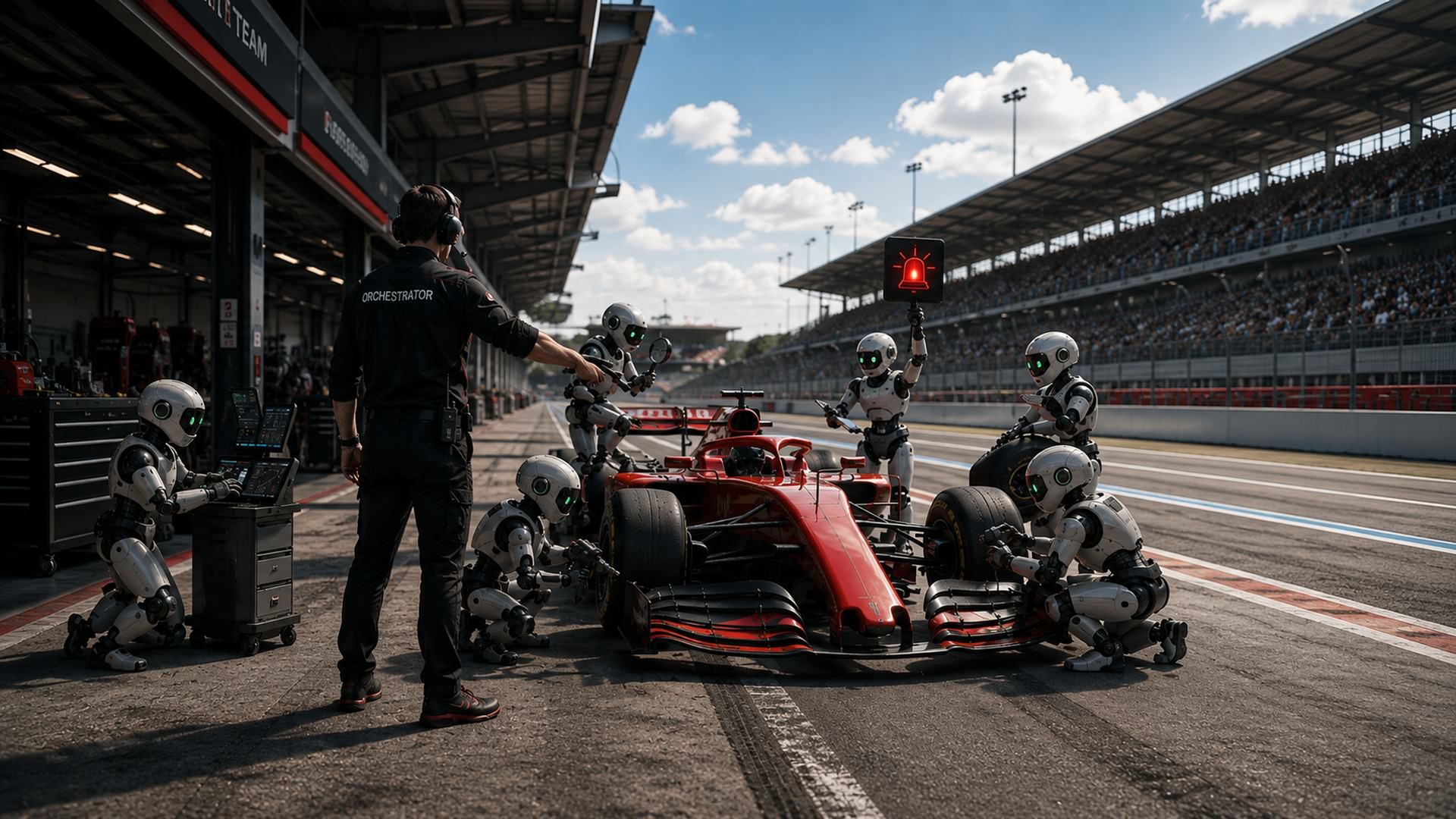
Everything so far has me as the dispatcher: I open N agents, each gets a worktree, I review N diffs. The next step up is one long-lived coordinator agent I talk to instead, which routes each request to the repo that owns it and dispatches a worker there. Parallel agents vs. delegated agents.
The coordinator does not edit code. Its job is to route, dispatch, wait, verify, and report. The moment it starts editing files in another repo itself, the delegation has been skipped and you’re back to one agent doing everything, just with extra steps.
Each worker gets a fresh worktree in the target repo, and it picks up that repo’s AGENTS.md and the shared skills on its own, the same way any agent would if I’d opened it there directly.
This is the payoff for the whole first half of this post: the shared-skills investment is exactly what makes a worker dropped into a repo it has never seen behave correctly from the first turn.
The task spec is the entire handoff. The worker has no access to my conversation with the coordinator, so the goal, the acceptance criteria, the ticket, and where to stop all have to go in the spec.
What does not go in the spec: the target repo’s own conventions. The worker reads those from AGENTS.md itself; restating them just gives you two copies to keep in sync.
One task, one repo, one worker. If a change spans two repos, that’s two tasks with a dependency between them, not one worker reaching across a repo boundary it doesn’t own.
Supervision looks different from babysitting a single agent:
- Wait on a mailbox, don’t poll. The coordinator blocks until a worker reports back, instead of checking in every few seconds.
- Relay, don’t answer. If a worker escalates a question, the coordinator passes it to me; it doesn’t guess on my behalf.
- Read the diff, not the status. “Worker succeeded” means it finished, not that it did the right thing. I still read the actual change before I believe the report.
The mechanics come from Orca, the same worktree manager I use for parallel agents, extended to orchestration: a mailbox for dispatch and reports, and a task attached to a terminal.
orca orchestration send --type task_dispatch --repo <repo> --task "<spec>"
orca orchestration check --wait
Keep the command detail minimal in your own notes too. This post is about the pattern, not the CLI, and the CLI is the part most likely to change.
Model tiering. The plan-first section above already said “a smaller/faster model can implement it” without saying which. Now I can be concrete:
- Small and fully specified (a submodule bump, a rename, applying a known fix):
codexongpt-5.6-luna, orclaude-haiku-4-5on a machine without Codex installed. - Ordinary implementation from a clear spec:
claude-sonnet-5. - Genuine judgment (design work, an unclear root cause, a refactor):
claude-opus-5.
The non-obvious part: Orca has no model parameter. Its --agent flag picks the CLI, and each CLI launches on its own default; for Claude that’s the strongest model available.
An unspecified worker is an expensive worker by default. Pinning a different model means creating the terminal with an explicit command and attaching the task to it, not passing a flag to the dispatch itself.
When unsure, start one tier down and re-dispatch if the worker struggles. Re-running a cheap worker still costs less than defaulting every task to the most expensive model.
Agents that learn: every lesson gets committed
This is the part of the setup I care most about. When I correct an agent, I don’t want a one-off fix: I want the underlying instructions to improve so no agent ever repeats the mistake.
The playbook defines a correction ladder. Every durable lesson gets promoted to the strongest form available:
- Mechanically enforceable? → a pre-commit or CI hook. This is the strongest form because it doesn’t depend on any agent reading anything.
- A hard rule, but not enforceable? → one tight line in
AGENTS.md, which is auto-loaded every session. - A judgment call? → prose in the specific playbook or skill that someone doing that kind of work will actually open.
And two things are explicitly banned:
- No “lessons learned” log file: an unread append-only doc doesn’t prevent recurrence. If a lesson matters, it becomes a rule where it will be seen; if it doesn’t, it’s noise.
- No agent-private memory: memory stores are invisible to other agents and other developers, and they don’t get reviewed. Everything lands in version-controlled markdown. The one carve-out is machine-local state (which binary is disabled on this laptop, how to recover a local misconfiguration): that’s a fact about one machine, not a lesson other agents need, and it may stay local.
Scope matters too: a cross-repo lesson goes to the shared repo, a repo-specific one to .agents/local/.
Either way, the agent proposes the change and I review it, same as any code.
Every failure is a learning opportunity, and no learning is done until it’s written down. Each time an agent gets something wrong, the lesson must end up in a committed markdown (or a hook). That’s what turns one person’s correction into something the whole team, and every future agent session, benefits from.
The side effect I didn’t expect: writing rules for agents made the documentation better for humans. Every “why” an agent needs is a “why” a new teammate needs.
Code standards as rules agents can follow
“Follow the existing code style” is useless as an instruction, because most codebases contain both the pattern you want and the legacy pattern you’re trying to kill. An agent (like a new hire) can’t tell which is which.
My fix is a single code-standards.md file where every quality rule has an ID, a canonical example, and known violations:
- The rule itself (e.g.
retry-policy: all API retries go through the shared retry decorator). - A canonical module to copy, pointing at real code in the repo.
- The list of known violations, marked inline in the code:
# LEGACY[retry-policy]: migrate to the shared api_retry decorator
@backoff.on_exception(...)
def _request(self, ...):
The marker means “this pattern is superseded; don’t copy or propagate it”. Agents are told to never introduce a new violation and to check their own diff against the rules before finishing. A pre-commit hook regenerates a per-package status report from the markers, so there is always an up-to-date map of what’s clean and what’s legacy.
The important part: the whole codebase was swept once against every rule. A package with no markers is genuinely clean, not just unexamined, so the agent can trust the map.
Guardrails so the docs themselves don’t rot
Here is the uncomfortable lesson: instructions drift exactly like code does. When I audited my own setup, I found links to a file renamed months earlier and a rule duplicated in two files, where one copy described a pattern that no longer existed in the code. Nobody broke these on purpose; they rotted because nothing was checking them.
The fixes follow the same philosophy as everything else:
- Single-source every rule: one file owns each rule; everywhere else keeps a one-line pointer with the rule ID.
- Lint the links: a pre-commit hook fails if a relative markdown link doesn’t resolve. The day I added it, it caught two more broken links I hadn’t noticed.
- Identify the binary, don’t just resolve the name: a setup script needed to detect whether the Orca CLI was installed.
command -v orcalooks like the obvious check, and it’s wrong: on most Linux desktopsorcais also GNOME’s own screen reader at/usr/bin/orca. The check passed, found the wrong binary, and running it switched on my screen reader. A check that merely passes is not a check that is correct, and automation that runs on teammates’ machines has to identify what it executes, not just resolve a name.
If your agent instructions have no mechanical checks, assume they are already partially wrong. Mine were.
What I’d tell you to steal
If you only take a few things from this post:
- One provider-neutral entrypoint per repo (
AGENTS.md), with tool files as one-line pointers. Enforce it with a hook. - A shared repo for cross-repo guidance, mounted as a pinned submodule, with lazy skills for workflows and always-on playbooks for behavior. It scales to as many shared repos as you need.
- A correction ladder: hook if enforceable, one line in
AGENTS.mdif hard, playbook prose if judgment. Never a lessons log, never private memory. - Plan in markdown, then implement: the plan survives lost sessions, gets reviewed before code exists, and lets a cheaper model do the typing.
- Run parallel agents in git worktrees: isolated checkouts mean no clobbered diffs, and tools like Orca set them up for you.
- Delegate across repos instead of dispatching yourself: one coordinator that routes, waits, and verifies scales further than you fanning out agents by hand, and it only works because each worker can read a repo’s own conventions on arrival.
- Treat the instructions as code: single-sourced, link-checked, reviewed in PRs. They rot otherwise.
What’s next for me: measuring whether agents actually follow the rules (the status report from the LEGACY markers is a start), and growing the shared repo as more repos and more agents join the setup.